A château near Bayeux, as your base for the D-Day beaches
Bayeux is the natural starting point for the D-Day beaches — and a hotel in town is not the only way to sleep there. Thirty-five minutes away, at the end of a five-hundred-and-sixty-metre drive, the château has six bedrooms, parking in the courtyard and the silence of the Normandy countryside.
Why sleep here rather than in town
The beaches are a driving day, and from the château everything is within reach: Bayeux is 35 minutes away, Caen and its Mémorial 30, Omaha Beach 55. In the evening you drive back to a stone-walled bedroom with a window onto the park.
- Six bedrooms in three sizes — all looking onto the park or the meadows.
- Private, free parking in the courtyard, no booking needed.
- Check-in between 4 pm and 10 pm, check-out before 11 am.
- Breakfast is served from 8 to 10 am; the château serves neither lunch nor dinner — we keep a list of places to eat in Bayeux and nearby.
- Without a car: train to Caen (about 2 hours from Paris Saint-Lazare), then a taxi or ride-hailing car.
The beaches in one day, in order
This is the day most first visits book. Bayeux is the starting point, then the coast from east to west. One tip before you set off: check the time of low tide — Arromanches and Omaha are at their best at low water.
-
Bayeux
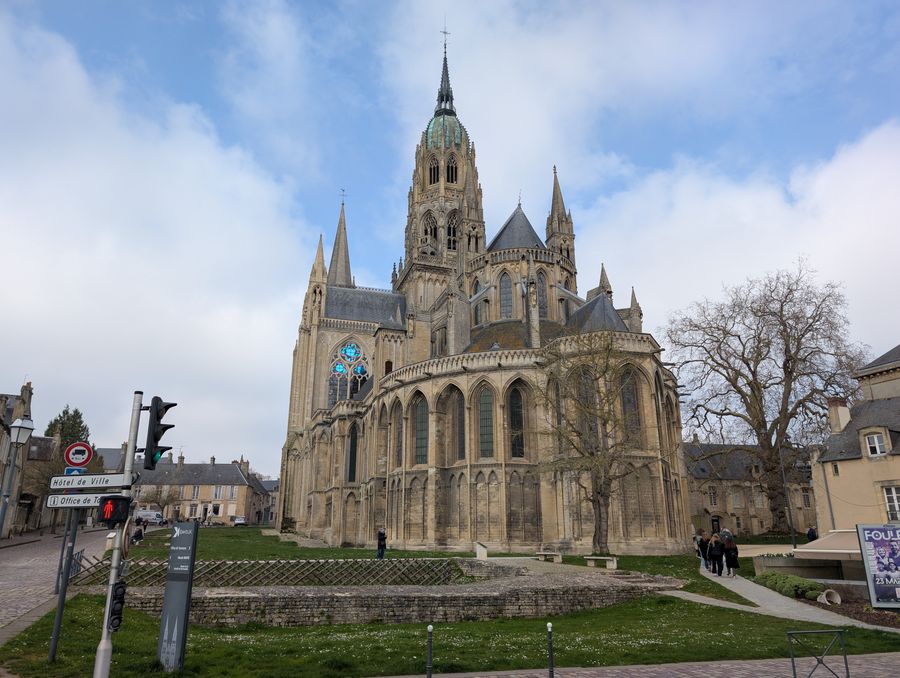
Until October 2027 the Tapestry is not in Bayeux: its museum has been closed for rebuilding since 1 September 2025, and the embroidery is on show at the British Museum in London from 10 September 2026 to 11 July 2027. The town itself is unchanged: Notre-Dame cathedral, Romanesque and Gothic, which came through 1944 without a scratch; the lanes along the Aure; the Memorial Museum of the Battle of Normandy and, opposite it, the Bayeux War Cemetery, the largest Commonwealth cemetery of the Second World War in France. On Saturday mornings, the market.
-
Arromanches
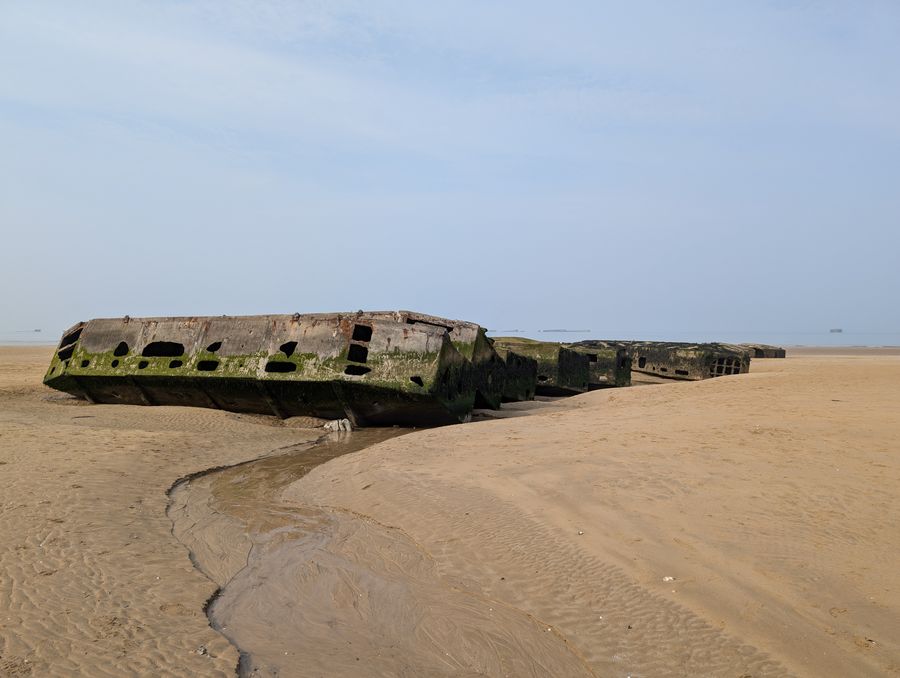
More than thirty caissons of the Mulberry artificial harbour are still there, stranded on the sand, and the sea takes a little more of them each winter; at low tide you can walk out to them from the beach. On the seafront, the D-Day Museum has been entirely rebuilt — three storeys of glass, reopened in 2023 and inaugurated on 6 June 2024 — and tells the engineering story of a harbour that came from England.
-
Longues-sur-Mer
Free to enter, free to park, and the only battery on the Normandy coast that has kept its guns: four casemates with their 150 mm pieces, and on the cliff edge the fire-control post, which you can go inside. Between Arromanches and Omaha it is the short stop that best shows what the beaches were up against. Guided tours from April to October, from the tourist office at the entrance.
-
The American cemetery and Omaha Beach
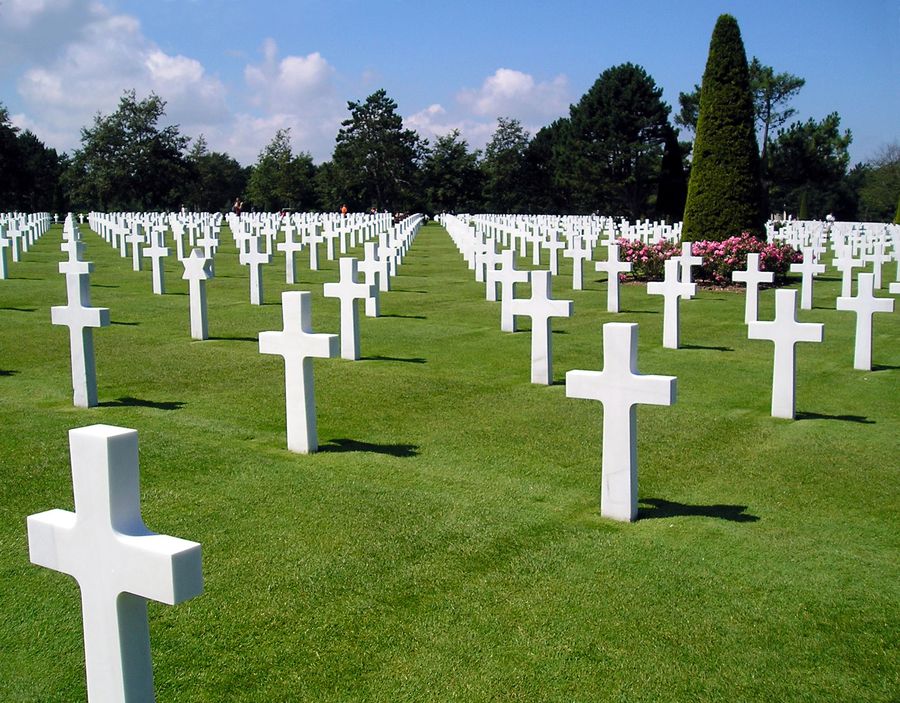
At Colleville-sur-Mer, above the beach: the American cemetery is open daily from 9 am to 5 pm (except 25 December and 1 January), free of charge, last admission half an hour before closing; since April 2026 groups register in advance — check abmc.gov. Then walk down onto the sand of Omaha, immense at low tide; the Omaha Beach Memorial Museum rounds off the visit.
-
Pointe du Hoc
The craters and bunkers have been left as they were — but the site is being restored against cliff erosion from February 2026 to mid-2027: since mid-May 2026 you enter by the western path only, and some of the paths and bunkers are closed. Entry is still free, allow an hour, and check the state of the site before you go. It is the end of the day, facing the sea, before the drive back to the château.
Opening times and closures checked on 31 October 2026 — confirm before you set off.
With a second day
The Mémorial de Caen, thirty minutes away, sets the Battle of Normandy in its century: allow at least three hours (open 9 am to 7 pm from April to September, shorter hours the rest of the year). Further west, Sainte-Mère-Église and its Airborne Museum — two hours, open every day, 10 am to 6 pm in winter — and then Utah Beach need a full day. And if the stay runs longer, the Côte Fleurie, Honfleur and Mont-Saint-Michel are each a day's drive — and you come back to sleep here.
1944, here too
The château did not watch the summer of 1944 from afar: the area was fiercely fought over and the house bears the marks — roof collapsed, a wing reduced to its walls — in the photographs kept in its history room. What we know, what we are still looking for and the rule we have set ourselves are on the 1944 page.